Hair Spa vs. Regular Conditioning: What’s the Real Difference
Conditioner and hair spa treatments often get talked about as if they’re the same thing at different intensity levels, just “more conditioning.” That’s not accurate, and it leads people to either overpay for a hair spa when conditioner would do the job, or underinvest in scalp care when a hair spa is actually what they need.
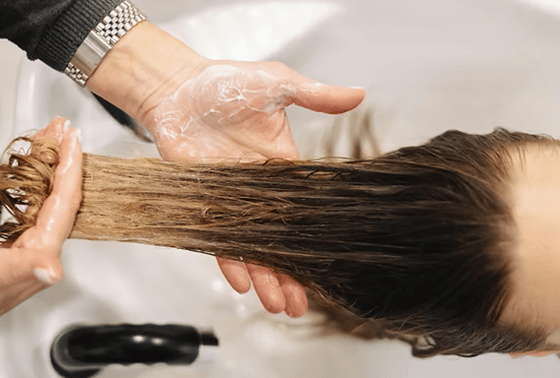
What Regular Conditioning Actually Does?
Regular conditioner is built for frequency, not intensity. It works mostly on the hair’s outer cuticle, providing surface hydration, smoothness, and detangling rather than penetrating deeper into the hair structure. That’s by design. It’s meant to be used after every wash, so it has to be light enough not to weigh hair down or require extended processing time.
This makes regular conditioning genuinely effective for everyday maintenance, but limited in what it can fix. It smooths what’s already there. It doesn’t repair structural damage underneath.
What a Hair Spa Treatment Actually Targets?
A hair spa works on a fundamentally different scope. Unlike regular conditioning, a hair spa treatment also involves the scalp, rather than focusing only on the mid-lengths and ends. That distinction matters more than it sounds, since scalp health and hair health aren’t the same problem, even though they’re connected.
A hair spa offers a holistic experience focused on scalp health and overall hair nourishment, while deep conditioning is targeted specifically at the hair strands for intense repair and hydration. In practice, that means a hair spa is addressing dandruff, oiliness, scalp sensitivity, and circulation, none of which a leave-in conditioner or weekly mask is designed to touch.
Why This Distinction Actually Matters?
If your problem is dry, frizzy ends with otherwise healthy roots, a hair spa is solving a problem you don’t fully have. A good deep conditioning mask will get you most of the same benefit for less time and money. But if your scalp itself is the issue, oily, flaky, itchy, or just generally unbalanced, conditioner can’t reach that, no matter how often or how generously you apply it. You’d be treating the symptom on your strands while ignoring the actual source at the root.
How to Actually Decide?
The simplest way to figure out which one you need is to separate the two questions. Ask what your hair feels like versus what your scalp feels like. If your strands are rough, brittle, or prone to breakage but your scalp feels normal, conditioning is the faster, cheaper fix. If your scalp itself feels uncomfortable, congested, or out of balance regardless of how your hair looks, that’s a scalp problem a basic conditioner was never built to solve.
A proper hair spa madrid session is worth booking specifically when that second category applies, not as a routine upgrade to your regular wash-day conditioner.
Using Both, Without Wasting Money on Either
These two treatments aren’t competitors. Conditioning is daily maintenance. A hair spa is a periodic, deeper intervention for issues conditioner isn’t built to reach. Using both isn’t redundant, as long as you’re using each one for the problem it’s actually designed to solve, rather than treating a hair spa as a fancier version of something you could’ve done at home with a five-dollar bottle.